
American housing · September’s inflation report
Home truths
September’s inflation report measures the price of shelter, but households also have to find somewhere they can afford.
The world economy is still expanding, but the countries paying for expensive energy are not necessarily those profiting from the technology boom.
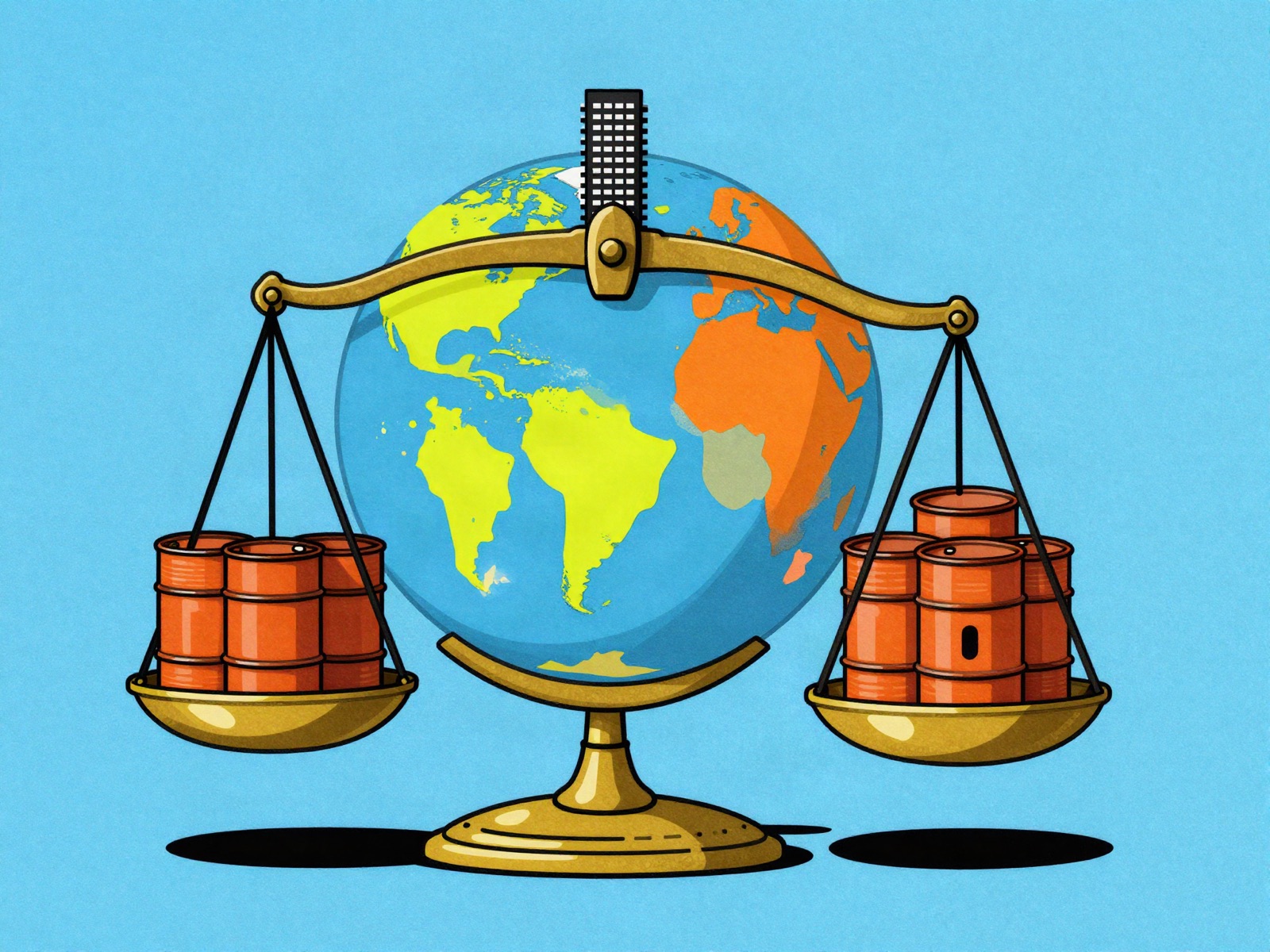
Bangkok hosted an argument about the world economy’s resilience while Thailand’s own outlook illustrated its limits. The International Monetary Fund’s October forecast puts Thai growth at 2.1% this year, against 4.4% for its ASEAN-5 grouping. Its global forecast is 3.1% for 2026 and 3.4% for 2027. The figures, released on October 13th, describe an expansion whose benefits depend heavily on what a country produces and how it buys its energy.
The Thai comparison is more revealing than the world average. The Nation’s October 18th report on the annual meetings noted that higher energy import costs were expected to push Thailand’s current account into deficit. The IMF’s tables put that deficit at 1.2% of GDP this year, following a surplus last year. Output can keep expanding while a country must devote more of its resources to paying foreign suppliers.
These are forecasts based on information available through October 1st, not final results. Nor do they demonstrate that energy alone explains Thailand’s relatively weak growth. They do expose the limitation of calling the global economy resilient without asking whose income is being protected and whose purchasing power is being lost.
The Fund’s account of technology trade names a concentrated set of beneficiaries. Taiwan and South Korea dominate the supply of advanced computing hardware; the United States and China are major centres of demand for that equipment and of data-centre construction. Other economies participate by supplying components, commodities or services. Merely being located in Asia does not confer the same position in this chain.
The economic distinction is between receiving orders and paying for inputs. Hardware exporters receive demand from the investment boom. Energy importers face a larger bill before any gains from using new technology arrive. An economy can experience both at once. Its balance depends on the industries involved, their local suppliers and the extent to which export earnings reach other households and businesses.
Energy exporters also need separating. Higher world prices can benefit producers outside the conflict zone. For Gulf suppliers whose production or shipping is disrupted, the ability to deliver remains decisive. The IMF identifies the restoration of maritime trade as a condition for some of their gains from technology-related demand. A higher quoted price cannot compensate for every interruption in sales.
The report also distinguishes today's investment from tomorrow’s productivity. Building computing capacity creates orders immediately; spreading useful applications across an economy takes longer. Its review finds a gap between gains demonstrated in particular tasks and the less decisive evidence in economy-wide statistics. That is a reason to examine adoption and output, rather than treat every equipment purchase as productivity already achieved.
This matters for countries trying to join the boom. Purchasing imported systems creates a financial commitment before it proves a local benefit. The relevant return is additional output or better service relative to the resources used. A national investment announcement, however large, cannot establish that return. Equally, weak participation in hardware exports does not rule out gains from using the technology well.
At the meetings, the political disagreement was partly over this sequence. Reuters reported that Kristalina Georgieva, the IMF’s managing director, stressed cooperation over war, AI and inequality, while the American delegation, led by the Treasury’s Erin Browne in the absence of Scott Bessent, hailed the momentum of America’s economy. The disagreement was not resolved by the positive global forecast: it concerns how confidently governments should count benefits that have yet to spread.
The fiscal constraint was more immediate. The Nation reported warnings from Rodrigo Valdés, the head of the IMF’s fiscal department, about high debt alongside higher interest costs and deficits that were widening instead of narrowing. The Asian Banker’s October 19th review likewise paired the stronger growth forecast with inflation and financing risks. Continued world growth does not give an indebted importer the tax receipts earned in a technology-exporting economy.
The Fund’s accompanying cost-of-living chapter examines the distribution of assistance during the earlier inflation surge. Its analysis of measures used in 2021–23 finds that broad energy-price subsidies directed much of their benefit towards higher-income households. Targeted transfers protected poorer households at a lower fiscal cost. This is evidence about earlier programmes, not a finding that every present government has implemented an effective alternative.
The mechanism is straightforward. Reducing a price subsidises purchases by affluent consumers as well as those struggling to pay. A transfer can support household income while leaving an incentive to economise on an expensive commodity. But that advantage depends on reaching the intended recipients. The chapter recognises identification and delivery problems, and circumstances in which a broader response may be warranted.
That leaves a concrete budget choice. Compensating vulnerable households and lowering everybody’s energy bill require different amounts of money and different administrative capabilities. A government cannot judge the programme from its effect on headline inflation alone. It must also account for who received support, who was excluded and the debt or taxes used to finance it.
Thailand’s forecast need not be a prophecy of permanent disadvantage. It is a warning against importing the optimism of better-placed economies. A government facing an energy deficit has to finance assistance with the resources it can raise, not the growth recorded elsewhere. The world average offers reassurance; it cannot pay that bill.
September’s inflation report measures the price of shelter, but households also have to find somewhere they can afford.

Japan’s latest business survey shows why scarce workers can coexist with cautious employers.

An oil shock has pushed America’s central bank into its first rate rise since 2023. Kevin Warsh may not be done