
Streaming advertising
The other customer
Netflix has cut its advertising-revenue forecast as new capabilities arrive more slowly than planned. Satisfying advertisers takes more than a growing audience.
Deere’s improving group profit conceals a weaker large-farm business. Calling the bottom still requires customers to place orders.
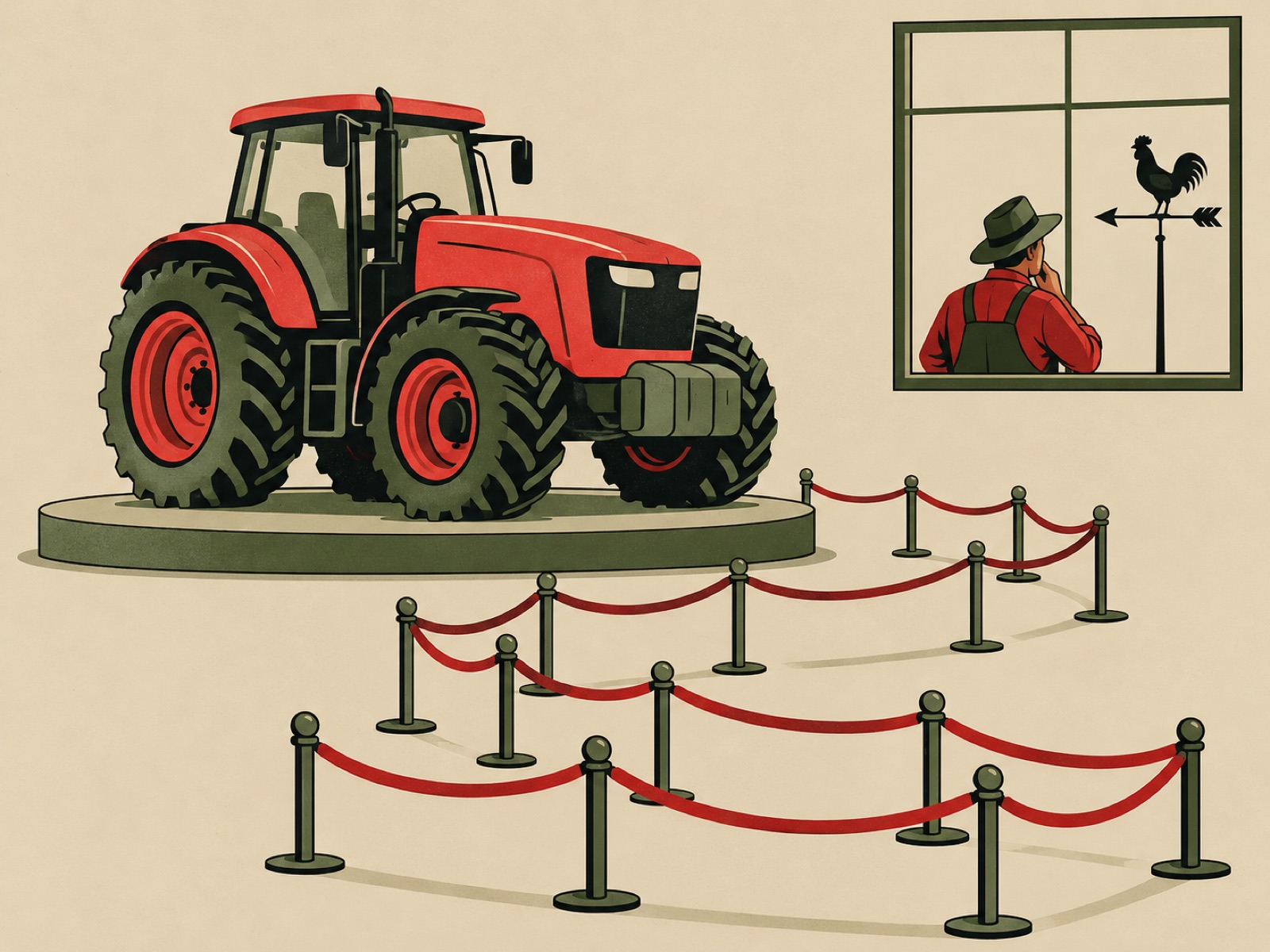
Deere’s profits have improved while its large-farm equipment business is still shrinking. In the quarter ended August 2nd 2026, net income rose 7% to $1.379bn. Sales in Production & Precision Agriculture, however, fell 6% to $3.998bn, and the division’s operating profit dropped 9% to $527m. The August 20th results give Deere grounds for optimism about the group without establishing that farmers have begun a new equipment-buying cycle.
A functioning tractor allows its owner to wait. Replacing it means weighing the gains from a new machine against financing costs, the purchase price and what the old equipment will fetch. Improved technology can tilt the calculation towards buying. It cannot remove the option of doing another season’s work with the machine already on the farm.
That makes Deere’s mix of customers important. A building contractor, a grounds-maintenance operator and a large crop grower need not decide to invest together. Their differing schedules can support the manufacturer while its largest agricultural machines remain harder to sell.
The divergence was visible in the preceding quarter. In the period ended May 3rd, Production & Precision Agriculture sales fell 14% year on year, while Small Agriculture & Turf grew 16% and Construction & Forestry grew 29%. Those are second-quarter growth rates, not the latest quarter’s. They show that the split between customer groups has lasted beyond a single set of results.
Diversification offers some protection, but Deere’s businesses still share a vulnerability: they sell expensive, durable equipment. Financing conditions and a reluctance to commit capital can affect several customer groups at once. Strength in construction therefore helps absorb agricultural weakness without guaranteeing protection against a broader investment slowdown.
There is also a gap between demand recovering and factory economics improving. A manufacturer can keep production high to spread factory costs over more units. If dealers cannot sell those units, the apparent efficiency leaves stock sitting elsewhere in the system. Cutting output can protect the dealer network while temporarily worsening the economics of each machine produced. A weaker margin may accompany a sensible inventory decision.
For that reason, neither busier factories nor a smaller stockpile is conclusive by itself. Production can rise ahead of demand, and inventory can fall because less is being made. The more persuasive recovery is one in which customers are taking delivery while dealers and factories avoid another build-up.
Used equipment can obstruct that recovery even when demand for the new machine looks promising. A farmer trading in a tractor pays the difference between its value and the replacement’s price. If dealers have too much used equipment, a lower trade-in allowance can make the upgrade more expensive without any change in the new machine’s advertised price. Clearing old machines helps reopen the market for new ones.
Deere’s management cited improving used-equipment inventories and early-order trends in August when it reiterated its expectation that 2026 would mark the agricultural cycle’s bottom. That remains management’s assessment. Its full-year net-income forecast was $4.75bn–$5bn. The quarter also included $110m of tariff recoveries, so the profit improvement cannot be read solely as evidence of customers spending more. The release contains both the hopeful signals and that qualification.
The historical comparison sets the scale of the recovery still needed. Deere reported fiscal 2025 net income of $5.027bn, down from $7.100bn in 2024. Its November 2025 statement already emphasised inventory management and cost control. An approaching bottom would mean the contraction was ending; it would not mean the earlier earnings level had been restored.
The dealer’s position is therefore more revealing than the group profit headline alone. Better trade-in values could ease the farmer’s replacement decision; orders must then become deliveries without leaving excess stock behind. Deere’s other divisions have given it room to manage that adjustment. The large-farm business still needs customers to decide that waiting another season is the more expensive choice.
Netflix has cut its advertising-revenue forecast as new capabilities arrive more slowly than planned. Satisfying advertisers takes more than a growing audience.
IKEA’s new European price cuts renew a difficult bet: accepting less on each sale can strengthen the business only if customers respond.
Costco’s membership income gives it room to compete on price. Keeping that income requires the bargain to remain convincing.