Germany · Chinese investment
Beyond the quayside
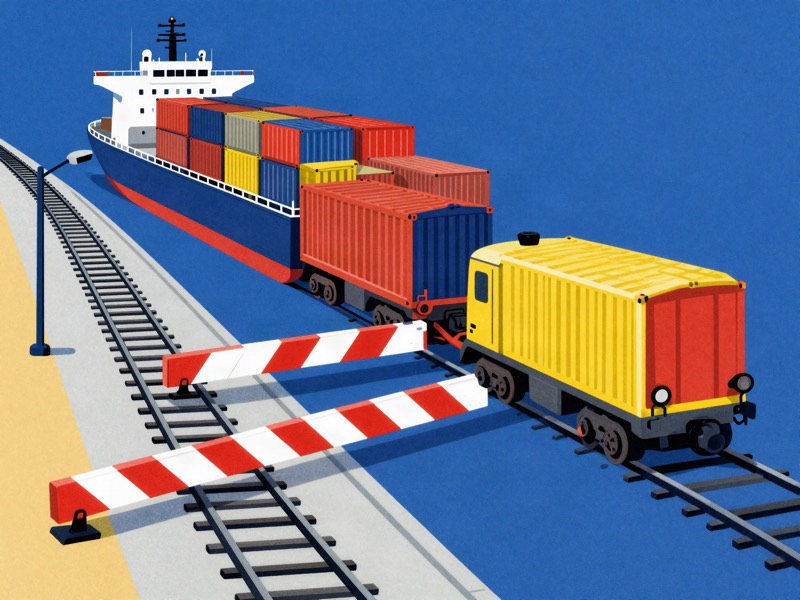
Blocking a Chinese takeover of Zippel puts the inland connections of Hamburg's port at the centre of an argument over economic security
New European listings focus on the services that connect restricted trade, but measuring their effect will be harder than naming the firms

A sanction is a legal restriction. Making it effective requires finding the people and businesses that keep a transaction moving. The European Union’s latest action against the circumvention of Russia sanctions, announced on October 15th, concentrates on that less visible work. The Council listed intermediaries it says helped move restricted goods, arrange payments and sustain Russian oil trade.
Among those named is MOVERS GROUP LLC, a Russian cargo company that the Council links to imports of restricted goods. United Stream LLC illustrates another function: the Council describes it as a Russian payment intermediary and alleges that it facilitated restricted imports from the EU. These are the Council’s stated grounds for sanctions, not findings of criminal guilt. Together, the examples explain why enforcement reaches beyond whoever manufactures or buys a product.
The action suggests a practical emphasis: restrictions depend on the services around a shipment as well as on the shipment itself. A manufacturer may need a distributor, a transport provider and a workable payment arrangement before a sale can proceed. Disrupting a consequential intermediary could therefore affect several transactions. Whether these particular listings will do so remains to be demonstrated.
The Council’s general explanation of sanctions distinguishes restrictions on goods and services from measures against named people and entities. Asset freezes and prohibitions on making resources available address the latter. The new listings add targets within that existing architecture; they should not be read as an announcement that every commercial connection with the countries mentioned has become unlawful.
For enforcement, this creates a demanding information problem. The company appearing on an invoice may be different from the business controlling a transaction or benefiting from its proceeds. Understanding the relationship requires evidence about ownership, control and the economic purpose of the deal. A simple match against a company name is a useful beginning, but an inadequate account of the whole task.
The European Commission’s asset-freeze guidance, current to late September, explains why ownership and control matter. Restrictions can affect assets of an unlisted entity controlled by a listed person, subject to the guidance’s case-specific qualifications. It also distinguishes freezing assets from expropriating them. These are consequential legal effects, but they do not establish how much property has actually been found and immobilised following the new announcement.
The Commission’s earlier due-diligence guidance takes a risk-based approach. It asks businesses to consider their products, counterparties and transactions, with closer examination where circumstances raise concerns. That document supplies background to the enforcement problem; it is not a new instruction issued with the October listings.
This approach has a useful discipline. An unusual arrangement can justify further checks without proving an offence. Treating every unfamiliar route or customer as illicit would obstruct legitimate commerce. Treating formally complete paperwork as conclusive would create a different weakness. The difficult task is to decide when the available evidence is sufficient, and when a transaction needs a more searching review.
There is a cost to that judgment. Staff must be trained, records reconciled and questions answered across companies that may not share systems or incentives. A seller can see an order, a carrier a consignment and a financial institution a payment. The wider pattern may be clearer to an authority able to compare those views. That is an analytical reason for better information sharing, not evidence that any particular company ignored a warning.
Counting new names is an easy way to describe a sanctions announcement. It is a poor standalone test of its effectiveness. A useful assessment would ask whether access to restricted inputs became more difficult, whether transactions were interrupted and whether substitute providers restored the same service. None of those outcomes follows mechanically from publication of a list.
Nor would a fall in an individual company’s activity, by itself, establish a reduction in Russia’s capacity to obtain goods or revenue. Business could migrate elsewhere. Conversely, a network might become more expensive and unreliable without disappearing altogether. Friction can matter even when prohibition does not produce a complete stop. The size and persistence of that friction require evidence, rather than a confident estimate assembled from the announcement.
The Council describes sanctions as targeted, proportionate and subject to review. That makes explainable decisions part of the policy’s credibility. Firms need to understand which restrictions apply and why. Authorities need a defensible basis for action. A system that cannot distinguish a prohibited connection from an incidental one risks wasting effort and damaging confidence among businesses whose cooperation it needs.
The choices after designation will determine the result: whether authorities identify relevant assets, whether businesses update their checks and whether information about replacement networks reaches investigators. Those are questions for subsequent reporting. The announcement provides no transaction-level account of the damage already inflicted by these particular measures.
There is a temptation to treat each addition to a sanctions list as another piece of a completed barrier. The better comparison is maintenance of a system whose users adapt. Intermediaries can be replaced, ownership can be hard to establish, and legitimate trade must still be distinguishable from prohibited activity. Europe has identified more links it wants to interrupt. Showing that the interruption lasts is the harder assignment.
Blocking a Chinese takeover of Zippel puts the inland connections of Hamburg's port at the centre of an argument over economic security

India is protecting sugar supplies by changing what can go into its fuel, exposing the agricultural limits of energy independence
A new reservation programme gives more ships a way to plan ahead. It cannot promise more rain